The second one was just pure fun. It took me a long time to let go of it, because I was afraid it was too "silly" and not "serious" enough. Enough of that.
I finally finished and uploaded a new track to Soundcloud. I am really happy with it. It is pure pop, but that is what I am enjoying creating these days. Two things about it:
One: I named it "Incompatible," because it came from doodling around with "incompatible audio units" in Logic and a scare window kept popping up, reminding me of the fact. As it grew, I realized it was about an important new relationship in my life, so I ran with it.
Two: I am singing almost entirely in falsetto. In a dialogue with Stretta about a year ago, he gently commented on the quality of my singing voice by commenting on his own ability to control his voice better when in falsetto. Hint hint. Got it. And it is true. To sing pop, you just can't fudge, you've got to hit the note dead on. And I still don't; but at least in falsetto I can fake it a little bit better. I also like, in a Brian Eno kind of way, the way in which the falsetto allows me to distance myself from my work, take on a persona, so to speak. And, heck, I just like the sound of falsetto in pop. Okay, so there is my apologia pro falsetto mia.
My great aunt has loved and played music all her life. Her instruments are keyboards: pianos, organs, accordions, and the Solovox. Growing up, I remember many a rendition of the Tenessee Waltz in the music room of her great big old house. Great uncle on the violin, Aunt on the piano. Every now and then the cool electronic whistle of the Solovox would come humming out of that piano cabinet. When I first saw and heard my Aunt's Solovox it was already 30 plus years old and sounded great. Well, they just don't make 'em like they used to.
In the 90's my Aunt bought one of those new-fangled midi-pianos. No need for the Solovox. But she is a smart one, and she kept it.
I visited my Aunt last month. I went looking for something in one of her closets. There was her Solovox! In storage! Sometimes considered the "first synthesizer" (there are many artifacts that could qualify), pure tube power! I had to take it out. My Aunt knows my love for music (although she has no love for the kind of music I like). She insisted that I take it home. Well, here it is:
Above is the underside of the keyboard unit. The keyboard is designed to be mounted underneath the keyboard of a grand piano. That long metal rod is the on-off and volume lever. It is designed to be operated by one's knee for dynamic control. RAD.
Here is a shot of the top of the keyboard unit shown, not as it ought to be, but placed on my grandmother's old coffee table.
The next picture is of the sound cabinet. This would be mounted within the piano's sounding board. Can you imagine someone being willing to do this to a piano?
The final picture is of the other side of the sound cabinet. Here you see the tubes in action. The thing still works (basically). And the tubes emit their yellow glow that says: you are now playing with electricity.
The two units are hooked up to one another by a (very proprietary) multi-pronged interface cord. Just so unbelievably rad. I can't wait to take it in to my local music shop and see what they can do with it. Even if they only clean it up and getting it in working order, that would be pretty cool. But I hope they could find a way to hack me into the (I believe five) formant filters on this thing!
Now, where to keep it I have no clue, but I am so happy to have this thing! It is both an amazing and historical piece of electronic musical equipment and a reminder of my cool great Aunt!
But what does it sound like? I am glad you asked. Here I am noodling around (top note priority):
After recording it with a friend, we started dropping different channel strip settings from logic on it. So I decided to turn it into a little electronica / techno / house track (still can't tell the differences between all those unbelievably specific sub-genres - does every artist / band just have its own sub-genre now? Doesn't that defeat the point? I digress).
Okay, so why didn't anybody ever tell me about Wire? I'm sure I had heard of them or read about them in other contexts but no one ever said to me: all the people that you like to listen to, listen to Wire and Wire is rad so you have to stop and give them a listen now.
So, apparently, Wire is the most under-recognized serious influence on punk, post-punk and new wave that I currently have finally found out about.
I am exploring their work and enjoying it. What I love about Wire is what I love about so much post-punk and early new wave: no fear of recording a short pop-song with both wild guitars and heavy and obvious synthesizer use.
I love Eno (like any synthesist should) -- but I love his early solo rock stuff as much as his ambient. I love a good synth-based song every now and then: but who ever said that being a synthesist meant that you had to be obsessed with music primarily driven by the synthesizer. I am not aware of there being any bass-rock out there. Or ambient bass music. (I know it is not a very good analogy, but just give this one to me, okay?)
I saw a documentary recently where the Edge talked about being the kind of guitarist who understood his role as being accompaniment to a pop-singer. I remember reading an interview of Nick Rhodes once where he talked about not being interested in novelty sounds, synth-solos, and bringing the synth to the fore of the music. He saw himself as created background atmospheres with strings, etc., and rhythmic interest through sequences and arpeggios. So the order is: singer, then guitar, then synth. I must admit that I am an odd kind of (amateur) synthesist: I basically like pop and rock music that is unafraid of bold and obvious synthesis but that still privileges rock's first two main instruments up front: the voice and the guitar.
Having finally figured this out about myself and becoming able to name it has allowed me to realize that it is hard to do the kind of synthesis and synthesizer accompaniment I really enjoy most listening to and contributing to because a.) modern DAWs hand you the capacity to make synth-rock on a platinum platter and b.) I do not actually have a band around me and I am what I would call BARELY proficient on the guitar. That being said, when I recently added an electric guitar to my project studio I was happy to discover how much easier it was to record a line-in distorted and/or heavily effected electric guitar and sound okay than trying to microphone record a nice take of acoustic guitar.
Oh, well. My bare proficiency at the guitar is a limitation that gives structure to my creativity. Besides, isn't barely proficient guitar what (post) punk music was and is all about anyway?
With that said, I have about three unfinished tracks that I am still working on but too self-conscious to share. I should have at least one of these up on Soundcloud and discussed here before summer is out.
I've been reading a lot of stuff about how "print media" is at an end. I understand the points that folks are making about this from a technological and practical point of view - and I experience this transition to the electronic, myself, to a certain degree. But to this bibliophile who also reads his local paper every morning with his family at breakfast, I must say, it is a kind of sad prospect to me. It is a little odd to be a web logger who prefers to read (and edit) things on paper. Computers are still a tool to me, rather than a means of reading.
If a book is just a means of dispensing, storing and looking up information, then goodbye to it. If a book is work of art in itself, then, as with all forms of art, I think it would be truly sad to see it go. So my title is a play on words. Perhaps print media is over. But it may not mean the end of the book (as in its discontinuation) if we take time to take a look at the end of the book (what a book's telos is).
The Book of Kells is not "print media." If print media must go the way of the Dodo, then I suppose I will survive it. But an illuminated manuscript is a work of art - and not printed.
In the west, ancient Christian art developed into stained glass windows on the one hand, and illuminated manuscripts, like the Book of Kells, on the other. Books are a Christian art-form. The book was invented as a means to preserve, teach, process (liturgically) and proclaim the Christian scriptures. Every literate culture has some means of preserving its writing. The codex predated Christianity in the ancient Mediterranean world. And codices are book-like in form. But the thing we call a book, when the word "book" is used to refer to a kind of material artifact that is paper or vellum bound between covers, is Christian. Its end is tied up in liturgical goals. A book is supposed to be beautiful in the same way that a church is supposed to be beautiful, and the robes of the altar party are supposed to be beautiful. Books are a liturgical art form: their end and goal is the glorification of the ultimate reality that Christians seek. The book as a means of glorifying utlimate reality thereby makes a statement as to the nature of that reality. So we shouldn't be surprised that books came out of a religious culture that claimed that God was "logos," word, narrative, story, reason, argument, logic, itself.
I am reminded of another project going on right now, the St. John's Bible:
I like and dislike the St. John's Bible. I dig the idea of not simply imitating ancient illuminated manuscripts but rather trying to bring illumination forward into the 21st century. But in this particular case it is often only the idea that I like. The actual execution of it (and you can here it in the word-choice of the illuminator himself in the video embedded, above) comes across as too romantic and self-involving on the part of the illuminator. Does "21st Century" mean inserting the modern, impermeable, individuated and consumerist "self" into the illumination? I don't mean to sound too critical, the St. John's Bible is lovely. And the illuminator amazing. But one of the key parts of ancient illumination in the west, as with iconography in the east, was the spiritual principle of humility as anonymity. As an art form, iconography and illumination are about the expression of something transcendent to the cosmos itself - they are not about the expression of the "self," or the individual artist (except, of course, paradoxically as a microcosm of the cosmos itself). Oh wells.
This whole post was inspired by a viewing of The Secret of Kells, which is a truly remarkable movie:
It is, for a movie, an example of the kind of art that I always hope that any form of art can aspire to: I wish there were more books like the Book of Kells, and more animated movies like the Secret of Kells. It is scintillating. The scenes where the main character is walking alone in the woods are amazing: the light shining through the moving trees above is rendered as patterns appearing within the form of the character himself who is rendered as kind-of semi-transparent. Amazing. The whole thing is so visually overwhelming that by half way through I just gave up trying to notice it all and I just let it wash over me. On top of all that, the movie celebrates the book as a religious art-form. At one point, the main character battles a supernatural enemy through his skills as an illuminator. I could go on and on but I won't. Needless to say, I will have to give this film multiple viewings.
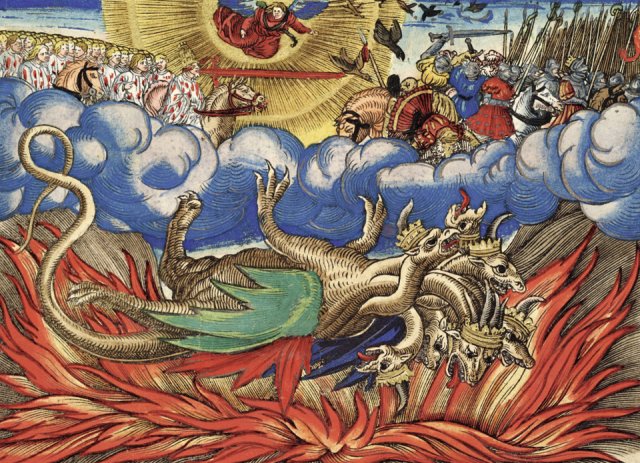
Finally, I think that the print industry will survive, but I imagine that to do so it may have to go "specialty," that is to say, printing stuff that takes advantage of the art-form of the book and that which is art-like in print itself. To sell books, they will have to be more than information storage and retrival. They will have to be beautiful. They will have to be things that you wouldn't want on a computer screen. When I think about that, I think of Taschen, check them out. They produce books with rich images, like that below, that you wish you could see on a beautiful clay paper page, rather than on my web log: